





Agentic AI for IT Service Management
Autonomous agents that triage, diagnose, and remediate incidents across your ITSM stack—securely and with full auditability.
The Problem
Modern ITSM environments operate under constant pressure as incident volume grows and signals fragment across tools. Critical decisions—severity, routing, remediation—remain manual, extending MTTR and increasing operational risk.
Incident floods overwhelm teams and dilute signal quality.
Criticality is often determined manually and inconsistently.
Repetitive investigations slow resolution cycles.
Context is scattered across tools and tribal memory.
Audit trails are incomplete or manually compiled.
Agent Capabilities
Agent Capabilities define how autonomous agents operate within your ITSM ecosystem—classifying incidents, correlating context, executing approved runbooks, and continuously learning from outcomes.
Auto-triage incidents, assign severity, and route to the correct CI + owner.
Auto-categorize, prioritize, and reduce ticket noise so queues reflect real work.
Works with your ITSM ecosystem
Aura connects to your existing ITSM, DevOps, and knowledge systems through tool adapters—so teams don’t change where they work.


Pilot KPIs
We align baseline → target → measured movement during pilot.
L1/L2 workload
MTTR
Reopen Rate
SLA Compliance
RCA Cycle Time
Your KPI
What the agent does
Aura follows a consistent loop—detect, diagnose, act with guardrails, and learn—while updating the ticket with evidence.
Detect → Diagnose → Decide → Act → Learn

Intake
Ingest incident + service context + recent changes

Triage & Correlate
Assign severity, dedupe noise, link related incidents

Diagnose
Propose likely cause using logs + history

Approve
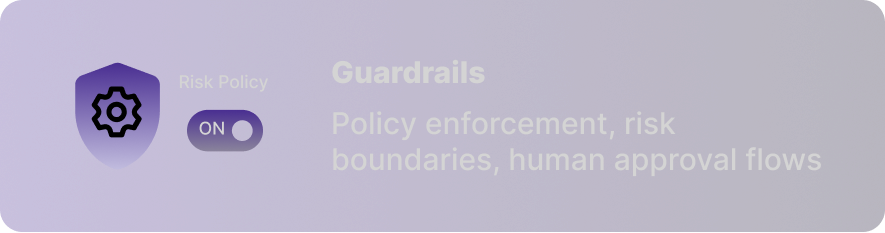
Apply risk policies / human approval if needed

Execute
Run automation / runbook safely

Document & learn
Update ticket, generate RCA, improve model

Example Agent actions
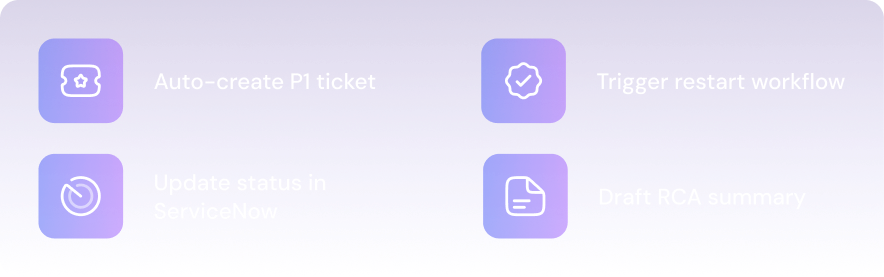
- Auto‑resolve Tier‑1 AMS tickets (access, config, known errors)
- Detect recurring failures → open RCA task → propose remediation plan
- Run approved scripts/runbooks → validate outcome → update ticket
Quality & Control
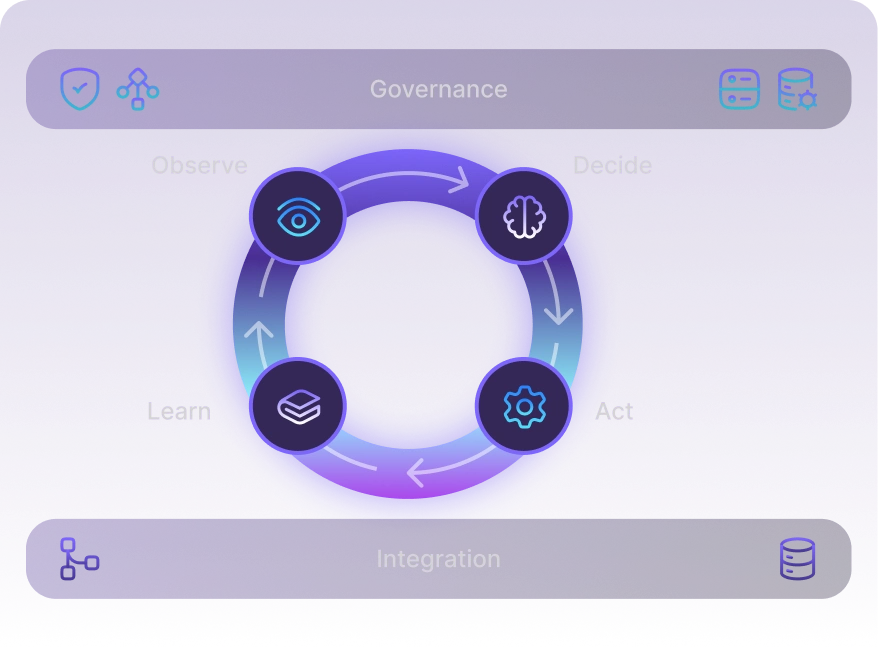
Reference architecture
Observe → Decide → Act → Learn.
Signals inform decisions, policies constrain actions, and every tool call is tracked—so automation is measurable and auditable.
Signals
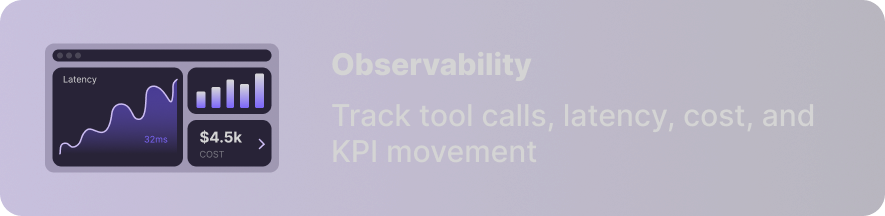
Track tool calls, latency, cost, and KPI outcomes with traceability.
Policies
Risk thresholds, approvals, access, and routing rules
Toolbox
ITSM, runbooks, DevOps tools, and knowledge systems
Audit
Evidence, logs, outcomes, and governance reporting
Pilot Plan
Focus on 2–3 high-volume workflows first, then expand based on measured results.
Intake, SLAs, baseline KPI capture
Stand up workflows + validation
Enhancements + automation expansion
KPI movement + scale plan