Why Migration Budgets Go Wrong
Ask five organizations what their S/4HANA migration cost, and you’ll get five wildly different numbers. That inconsistency isn’t because the technology is unpredictable — it’s because migration budgets routinely underestimate the scope of what’s actually involved.
The data confirms this. Industry research shows that over 60% of SAP migration projects exceed their original budget, timeline, or both. Roughly 65% of surveyed firms report severe to very severe quality deficiencies after go-live. These aren’t edge cases — they’re the norm when organizations treat migration as a technical upgrade rather than a business transformation.
An S/4HANA migration touches data, processes, integrations, custom code, user workflows, reporting, and compliance. When the budget only accounts for the technical conversion, everything else becomes a surprise.
The Real Cost Components
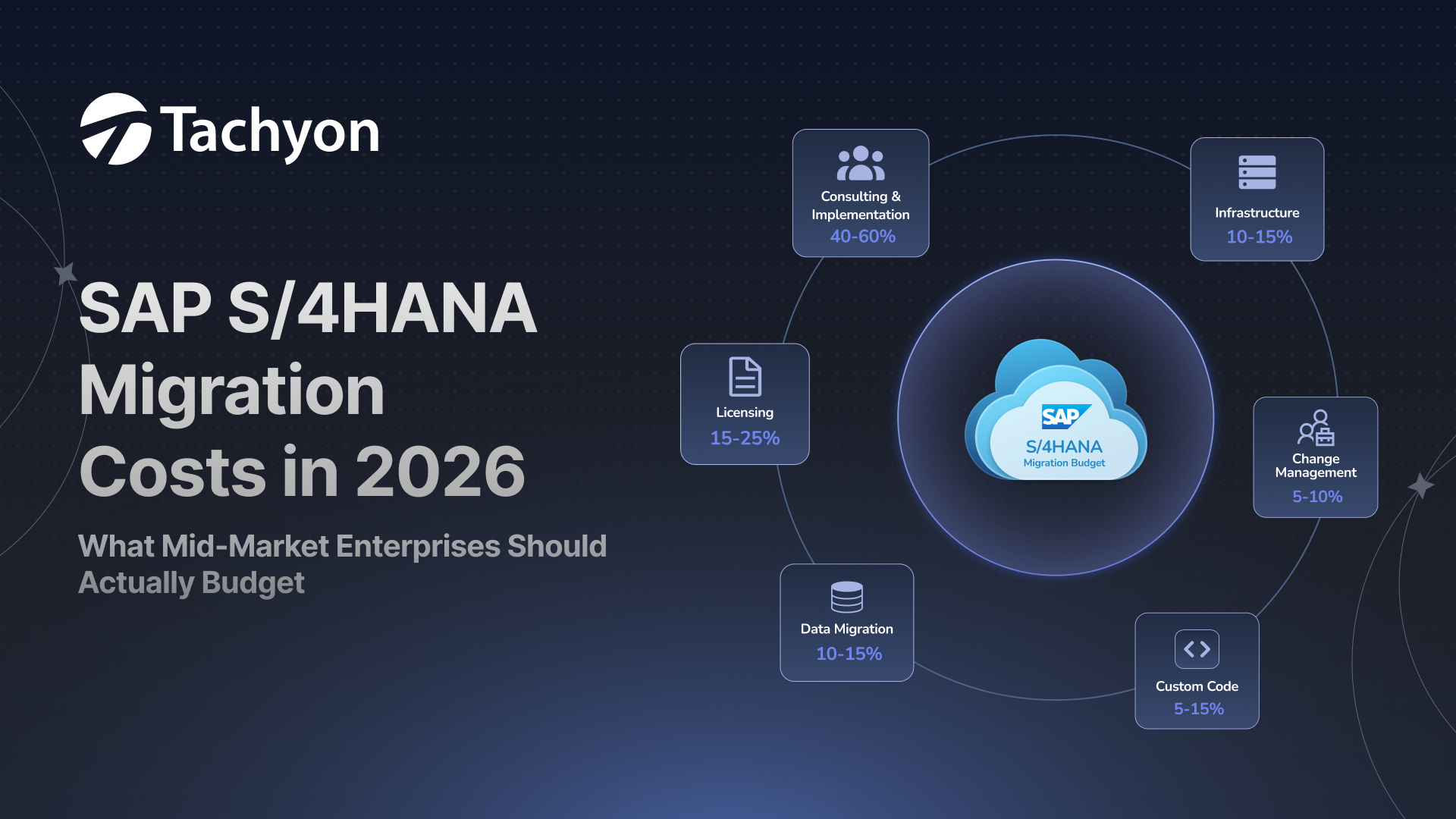
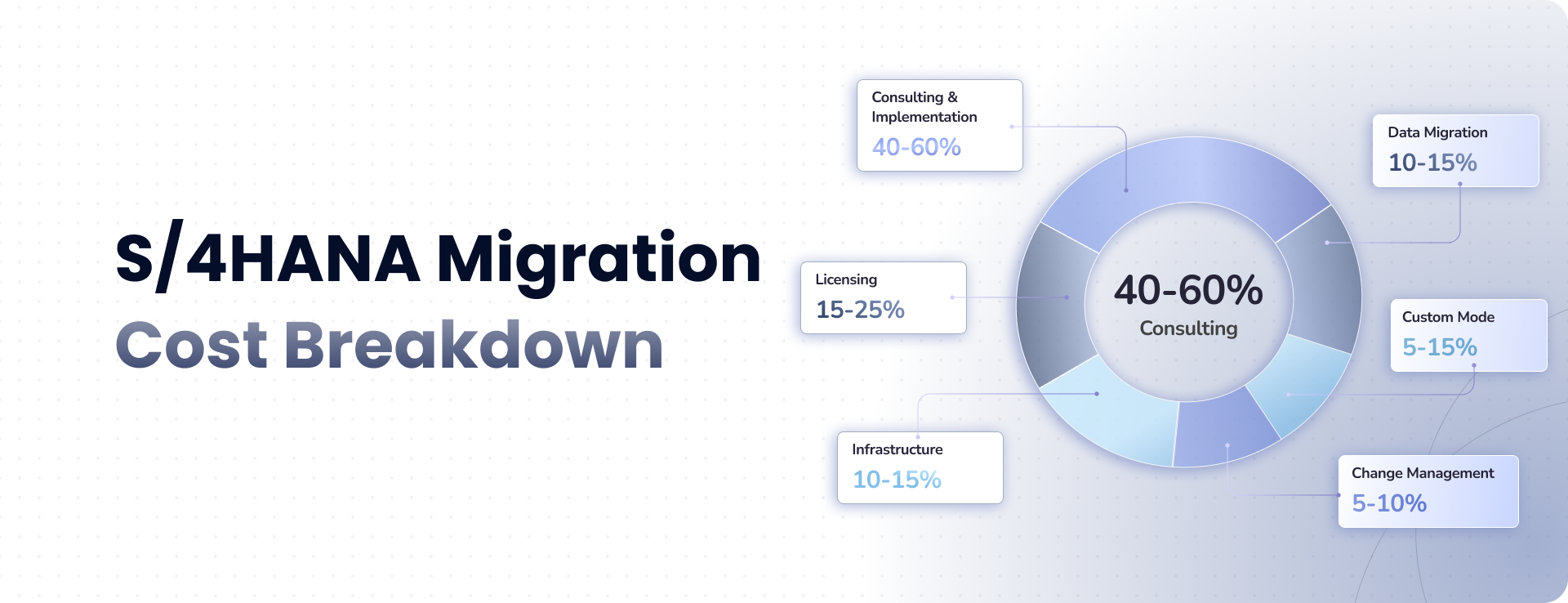
A comprehensive S/4HANA migration budget for a mid-market enterprise typically includes six cost categories, roughly in order of magnitude.
Consulting and Implementation Services
This is usually the largest line item — 40–60% of total cost. It covers discovery workshops, migration readiness assessments, technical architecture, configuration, development, testing, training, and go-live support. For mid-market enterprises, this typically ranges from $1M to $8M depending on complexity, scope, and migration path.
The critical variable is consulting rate pressure. The SAP consulting market exceeded $16 billion in 2025 and is projected to approach $39 billion by 2035. With nearly two-thirds of companies now fully live or in process on S/4HANA, the remaining third is competing for an increasingly constrained talent pool. That’s driving rates up 30–50% in 2026–27.
Licensing, Infrastructure, and Cloud
RISE with SAP bundles infrastructure, database, and platform fees into a subscription model. Licensing costs depend on your user count, modules, and whether you’re converting existing licenses or buying new. Industry data shows that 61% of organizations plan to leverage SAP BTP alongside their S/4HANA investment, up from 57% the prior year — meaning licensing scope is expanding, not contracting. The shift from perpetual to subscription licensing also changes cash flow planning.
On the infrastructure side, budget for both migration-period costs (running ECC and S/4HANA in parallel for testing and cutover) and steady-state post-migration hosting. Whether you’re on hyperscaler (AWS, Azure, Google Cloud) or SAP’s own infrastructure, sizing depends on your data volume, transaction throughput, and disaster recovery requirements.
Data Migration and Cleansing
Data migration is where budgets quietly balloon. Cleansing master data, validating historical transactions, archiving or retiring legacy data, and ensuring referential integrity across modules all take specialized effort. Organizations with large data volumes or complex data structures should budget 10–15% of total project cost for data work alone. Industry research consistently identifies data quality as a critical but overlooked challenge, with organizations flagging both accuracy and transformation issues when moving legacy data into S/4HANA environments.
Custom Code Remediation
Every custom ABAP program, enhancement, and modification needs assessment for S/4HANA compatibility. The SAP Readiness Check and custom code analysis tools identify what needs changing, but the actual remediation — rewriting, testing, and validating — is labor-intensive. Organizations with fewer than 500 custom objects may face minimal costs here. Those with 5,000+ can face months of dedicated effort before the conversion even begins. Recent industry surveys cited customizations (44%) and business process change (49%) as top migration barriers — underscoring that this is often the single largest variable in both timeline and budget.
Change Management and Training
Often the most under-budgeted category. S/4HANA’s Fiori UX is fundamentally different from the classic SAP GUI. Business processes may change. Reporting workflows shift. Organizational resistance was cited by 37% of respondents as a top barrier to migration. Without adequate training, communication, and executive sponsorship, user adoption suffers and the organization doesn’t realize the ROI that justified the investment in the first place. Budget for role-based training, not just go-live walkthroughs.
How Migration Path Affects Budget
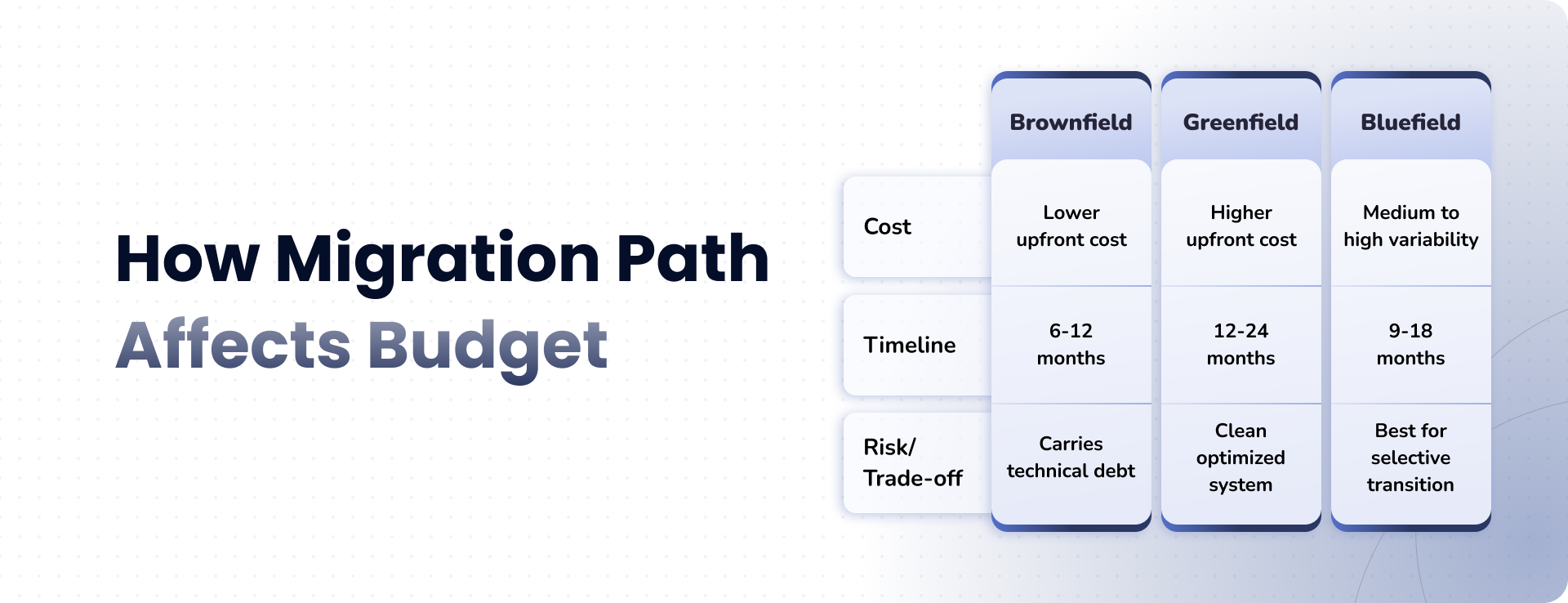
The choice between Greenfield, Brownfield, and Bluefield isn’t just technical. It determines your timeline, your budget range, and how much of your existing investment you carry forward.
Brownfield (System Conversion)
Typically the most cost-efficient for organizations with clean, well-documented systems. Your data, configurations, and customizations migrate with you — system ID, transaction history, and master data carry over intact. Timelines run 6–12 months for mid-market, with lower consulting hours and less change management because users stay in a familiar environment. Expect the lower end of the overall budget range.
The risk: you carry forward technical debt. Custom code that worked on ECC may need remediation, and data quality issues in the source become data quality issues in the target.
Greenfield (New Implementation)
Costs more upfront because you’re building from scratch — full process redesign workshops, new configuration, new data loads. Timelines run 12–24 months. The upside: a clean, optimized system with no inherited technical debt, processes aligned to SAP best practices, and significantly lower long-term maintenance costs.
Greenfield makes sense when your current ECC environment is heavily customized beyond recognition or when you’re using the migration to standardize across multiple business units or geographies.
Bluefield (Selective Data Transition)
Combines elements of both. You stand up a new S/4HANA environment but selectively migrate data, configurations, and customizations from the existing system. Timelines run 9–18 months, with higher variability because the approach requires precise data mapping, specialized tooling, and clear governance on what stays and what goes.
Bluefield is ideal for organizations that need process redesign in some areas but must preserve transaction history for compliance, audit, or operational continuity — common in manufacturing, energy, and life sciences.
The Timeline Reality
Regardless of path, industry data suggests that migrations are taking roughly 30% longer than originally planned. Most mid-market enterprises we work with at Tachyon land on either Brownfield or Bluefield. The key is running a thorough readiness assessment before committing — examining custom code volume, data quality, process documentation, and integration complexity.
The Hidden Variables
Beyond the core cost components, several factors can materially impact your budget if they’re not accounted for early.
Integration complexity is a major one. How many third-party systems connect to your SAP environment, and how will those connections change in S/4HANA? Every integration point — EDI feeds, middleware connections, API interfaces, data warehousing extracts — needs assessment and potential re-architecture. SAP Integration Suite adoption jumped from 33% to 46% year-over-year among surveyed organizations, reflecting how central this challenge has become. Organizations with 50+ integration points should budget integration work as its own workstream, not a line item buried in the implementation estimate.
Testing scope is another hidden budget driver. Comprehensive regression testing, user acceptance testing, and performance testing are non-negotiable — but the effort scales with your process complexity, integration count, and custom code volume. AI-powered testing tools can reduce the labor significantly, but they require planning, budget allocation, and early integration into the project timeline. Organizations that leave testing until the final phase consistently run over schedule.
Skills shortages are affecting most S/4HANA projects in 2026. Demand is particularly high for specialists in data migration, finance module configuration, testing and cutover management, and BTP development. When these skills are missing at critical project moments, delays multiply — and delays are the most expensive hidden cost in any migration. Planning resource needs 3–6 months ahead of each project phase is essential.
Timeline risk deserves its own line in every budget. Migrations that stall or extend past their planned go-live date accumulate costs quickly: parallel infrastructure (running both ECC and S/4HANA), extended consulting engagements (often at premium rates for overrun periods), and internal resource opportunity costs (your best people tied up longer than planned). The best defense against timeline risk is a realistic schedule based on a thorough readiness assessment — not an optimistic plan that assumes everything goes smoothly.
How to Build a Realistic Budget
Start with a Readiness Assessment
Before committing to a number, run a migration readiness assessment. This should evaluate your custom code inventory (volume, complexity, S/4HANA compatibility), data volume and quality (master data accuracy, historical data retention requirements), integration landscape (number, complexity, and technology of current connections), process documentation maturity, and organizational change readiness.
The assessment output gives you inputs for an accurate budget — not an industry average, not a vendor estimate based on module count, but a grounded projection based on your actual system state. Without this step, you’re guessing. And the data shows what happens when organizations guess: 60%+ budget overruns.
At Tachyon Technologies, we structure readiness assessments to produce actionable budget frameworks within 4–6 weeks. Organizations who invest in this upfront step consistently deliver migrations closer to budget and schedule. The assessment pays for itself many times over in avoided surprises.
Build in Contingency and Plan for Clean Core
For mid-market migrations, 15–20% contingency is prudent. If you don’t use it, you finish under budget and your CFO is happy. If you do, you’ll be glad it was there.
The Clean Core approach — minimizing custom code in the core system and extending functionality through BTP — is also a budget strategy. It reduces both the migration cost (less code to remediate) and the long-term maintenance overhead (less regression risk with every update). Think of Clean Core not as an architectural preference but as a financial decision that compounds savings over the life of your S/4HANA investment.
The ROI That Justifies the Spend
The cost conversation is incomplete without the return conversation. Industry data shows that S/4HANA migrations deliver an average five-year ROI of 547%, with an 11-month payback period. That ROI comes from reduced maintenance costs (no more extended support premiums), improved operational efficiency (real-time analytics, simplified data model, modern UX), better decision-making through embedded analytics, and access to innovation capabilities (AI, BTP, SAP Build) that ECC simply cannot support.
For mid-market enterprises specifically, the ROI case is particularly strong because the efficiency gains compound. S/4HANA’s simplified data model reduces database administration overhead. Real-time analytics eliminate the batch reporting cycles that consume analyst time. The Fiori UX reduces training costs for new users. And the Clean Core + BTP architecture lowers the cost of every future enhancement and upgrade. Mid-market IT teams, which typically carry more operational overhead per capita than large enterprises with dedicated centers of excellence, see disproportionate benefit from these efficiencies.
Conclusion
S/4HANA migration is a significant investment. But it’s not an unpredictable one — not if you approach budgeting with the right inputs. Start with a readiness assessment, not an industry benchmark. Account for every cost category, not just consulting and licensing. Choose the migration path that aligns with your system reality, not the one that looks cheapest on paper. And build in contingency for the variables you can’t fully control.
The organizations that budget realistically are the ones that deliver on time, on scope, and on ROI. They don’t treat migration as a technical upgrade — they treat it as the business transformation it actually is. That’s the migration your CFO wants to see, and it starts with the readiness assessment that makes every downstream decision more informed.
Ready to plan your S/4HANA migration budget?
Still trying to figure out what your S/4HANA migration will actually cost? Most budget estimates miss 30–40% of total project costs. Let’s build a realistic number together — based on your current landscape, not a generic template.